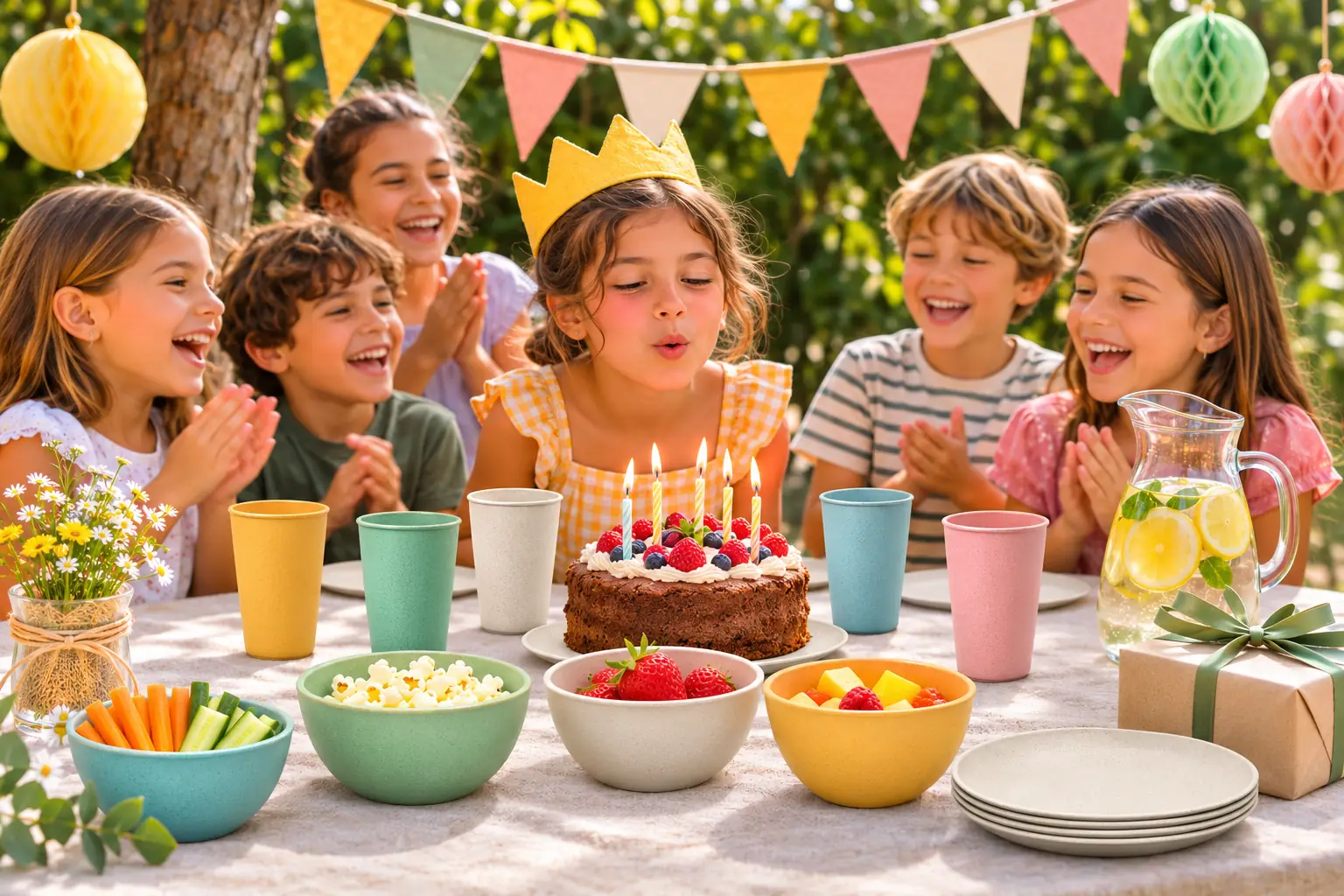
A sustainable birthday party doesn’t mean giving up cake, decorations or fun. It comes down to changing four or five specific decisions: what tableware you use, how you decorate, what gifts you give and what you do with the leftovers. In this guide, we’ll walk you through each stage, with alternatives that work just as well for children’s birthday parties as they do for adult celebrations.
If you want to understand the philosophy behind it, start with our article on what zero waste means. Here, we’ll get straight to the practical steps.
A sustainable birthday party is a celebration planned to generate as little waste as possible. It replaces single-use products with reusable alternatives, matches the amount of food to the actual number of guests and chooses gifts and decorations that won’t end up in the bin the following day.
It’s also known as an eco-friendly birthday party, a low-waste party or a zero-waste birthday. The idea is the same: it’s not about buying “eco-friendly” products, but about avoiding purchases that will simply be thrown away. A compostable plate used for ten minutes still becomes waste; a plate you keep for the next party doesn’t.
This approach follows the waste hierarchy established by Spain’s Waste Law 7/2022: prevention comes first, followed by reuse, with recycling or disposal only considered afterwards. A successful sustainable birthday party focuses mainly on the first two steps.
In just three or four hours, a birthday party brings together many products that have a significant environmental impact: cups, plates, cutlery, balloons, packaging and leftover food. Almost everything is bought for a single use, and almost everything ends up in the bin that same evening.
It’s no coincidence that European and Spanish regulations have focused on precisely these items. Spain’s Waste Law 7/2022 bans the placing on the market of certain single-use plastic products, including plates, cutlery, straws and balloon sticks. It also requires a 50% reduction by weight in single-use plastic cups by 2026 and a 70% reduction by 2030, compared with 2022 levels. Since 1 January 2023, single-use plastic cups provided to consumers must also be charged for separately and itemised on the receipt.
Food waste adds to the problem. According to the Spanish Ministry of Agriculture’s food waste report, Spanish households threw away 1,097 million kilograms or litres of food and drink in 2024, accounting for 97.5% of the country’s total food waste. Celebrations, where people often prepare extra food “just in case”, are occasions when this problem becomes particularly noticeable.
Most of the waste generated at a party is determined before it even begins, when you’re making your shopping list. Planning these four things carefully will prevent more waste than any action you take afterwards.
A paper invitation is read once and then thrown away. A digital invitation sent by messaging app or email serves exactly the same purpose, allows guests to confirm their attendance immediately and creates no physical waste. If you’d prefer something tangible, handmade invitations using reused paper or plantable seed paper are a perfect craft activity to enjoy with children in the days leading up to the party.
Ask guests to confirm their attendance a few days in advance and prepare food for the people who are actually coming, not those who might turn up. At children’s parties, serving smaller portions and topping them up as needed works better than filling every tray from the start. Food that stays off the table can be stored safely; food left out for an entire afternoon may not be.
The best decorations are the ones you can pack away in a box and bring out again the following year. Fabric bunting and garlands, a cotton tablecloth and a chalkboard displaying the birthday person’s name and age can replace all the disposable paper and plastic decorations that usually get thrown away after the party. Seasonal flowers, branches and leaves, or fruit arranged as a table centrepiece, look beautiful and can later be composted or eaten.
Avoid plastic confetti and glitter. Since October 2023, the European Union has banned the sale of loose glitter made from microplastics, specifically because of its environmental impact. Confetti made from punched-out dried leaves or recycled paper serves the same decorative purpose.
Balloons are probably one of the most problematic decorations at a party. A study by IMAS and Australia’s CSIRO, examining the causes of death of more than 1,700 seabirds, concluded that balloon fragments are the deadliest type of marine debris for these birds. When swallowed, they are 32 times more likely to cause death than hard plastics because they can mould to the digestive tract and block it. This is one reason why plastic balloon sticks are already banned in Spain.
If you still decide to use balloons, keep them to a minimum, never release them into the air and make sure they’re collected and disposed of properly afterwards. But there are equally eye-catching alternatives:
The table is where a birthday party can make the biggest difference to its environmental impact. It’s also one of the easiest things to change because practical alternatives are readily available and quickly pay for themselves.
If you can only change one thing, change the cups and plates. They’re among the bulkiest types of waste generated at any party, and they’re used repeatedly: each guest goes through several cups throughout the afternoon, especially children, who often leave drinks unfinished and pick up a fresh cup.
Many families choose “compostable” tableware thinking it’s the solution, but there’s a catch. Most of these products only break down in industrial composting facilities, under temperatures and conditions that aren’t available at home, and many end up in general waste. They’re also still single-use products: they have to be manufactured, transported and thrown away.
| Option | Number of uses | What happens after the party | Medium-term cost |
|---|---|---|---|
| Disposable plastic tableware | 1 | Waste; certain plastic plates and cutlery are already banned | Must be purchased for every party |
| Disposable “compostable” tableware | 1 | Waste; generally requires industrial composting | Must be purchased for every party |
| Household tableware (glass, ceramic) | Unlimited | Washed and stored | No additional cost, but a risk of breakages around children |
| Durable reusable tableware | Unlimited | Dishwasher-safe and stored for future use | One-off purchase that pays for itself after a few parties |
Using the tableware you already have at home is the most sustainable option if you have enough for everyone. When you don’t have enough, or when there are young children and you’re concerned about broken glass, durable reusable cups and tableware are a practical alternative.
At Ecogots, we manufacture reusable cups using Oryzite, a material in which 60% of the plastic is replaced with rice husks from the Ebro Delta, reducing CO₂ emissions during manufacturing by 72%. Our cups are durable and slightly flexible, so they won’t break if a child drops them on the floor. They withstand both hot and cold temperatures and are dishwasher- and microwave-safe. Once the party is over, simply wash them and store them for next time. And to complete your table setting, we also offer reusable bowls and plates, perfect for party snacks, afternoon treats or birthday cake.
Because they can be personalised, having a cup with each guest’s name also solves another classic problem at children’s birthday parties: nobody mixes up their cup, nobody picks up a new one every five minutes, and far fewer unfinished drinks end up being poured down the sink.
Individually packaged snacks, juice cartons with straws and small plastic water bottles create unnecessary packaging waste. Serve snacks in large bowls, prepare fruit-infused water or homemade lemonade in jugs, and buy loose or bulk products whenever possible, bringing your own bags or containers.
Homemade food not only creates less packaging waste but is often more popular with guests. Mini sandwiches, fruit skewers, Spanish omelette cut into cubes or homemade popcorn are ideal for any children’s birthday party. And if there’s food left over, divide it into reusable food containers for guests to take home instead of throwing it away.
A homemade cake or one from a local bakery avoids the plastic trays and packaging associated with mass-produced cakes. Ask for it to be delivered in your own container or a cardboard box, and avoid plastic cake toppers and figurines. Edible flowers, fruit or a message written in chocolate can be just as decorative.
Paraffin candles are often thrown away after being lit for just a few seconds. Beeswax or soy candles last longer and, if you choose a size that allows them to be reused, can serve for several birthdays. You could also use a wooden or ceramic number-shaped candle holder with space for a single candle, which can be kept and reused year after year.
Classic party games don’t require buying anything that will be thrown away: blind man’s buff, hide-and-seek, musical chairs, an outdoor obstacle course or a treasure hunt with handwritten clues. For younger children, a craft corner stocked with cardboard, bottle caps and fabric scraps can turn reused materials into the main activity.
Another great option is an activity where children can take home what they’ve made: planting seeds in clay pots, decorating a fabric bag or baking biscuits. This combines a fun activity with a keepsake from the party.
Birthday presents are often responsible for adding the most new objects to a home, and many are forgotten within a few weeks. Giving fewer, more thoughtful gifts is the most straightforward way to make a birthday celebration sustainable beyond the party itself.
Theatre tickets, an afternoon of climbing, a cooking class or a day trip create memories without generating physical waste. For children, second-hand books and toys in good condition can be just as exciting as new ones, and there are specialist shops and online platforms dedicated to them.
A group gift or shared contribution is one of the most practical solutions for children’s birthday parties. Instead of giving ten small presents, families pool their money to buy something the child genuinely needs or wants. This avoids duplicate gifts, unused toys and mountains of wrapping paper.
Wrapping paper is used for just a few seconds, and much of it cannot be recycled because it contains plastic coatings, glitter or sticky tape. Furoshiki, the Japanese technique of wrapping presents in cloth, turns the wrapping itself into part of the gift. You can also use a fabric bag, a jar, a reused box or newspaper decorated by the children themselves.
The plastic party bag filled with sweets and small toys is a classic that creates waste twice over: from the packaging and from the contents, which often break or get lost within a few days. Here are some alternatives that children appreciate just as much, if not more:
Even with careful planning, there will always be something left over. The difference lies in having a plan before the party ends, rather than dealing with everything once it’s been mixed together in a rubbish bag.
Set up a small, clearly visible waste-sorting station with three labelled bins: organic waste, packaging and general waste. If there are children, make sorting part of the fun and appoint a “recycling guardian”. Adults also tend to separate waste much more effectively when they don’t have to ask where each item belongs.
For leftover food, have reusable containers ready so you can share it among guests or freeze it for later. Food that cannot be used should go into the appropriate organic waste bin, never into general waste.
Finally, collect everything you plan to reuse: fabric decorations, bunting, cups and tableware. Wash everything, dry it thoroughly and store it together in a box labelled “parties”. The next birthday will already be half organised, and you can use the same box for other celebrations too, such as a sustainable Halloween.
Everything we’ve discussed also applies to adult birthday celebrations, with a few differences. For a dinner party at home, your own tableware and glassware will usually be enough, while reusable cups are ideal for larger parties or outdoor events, where glass isn’t practical. Drinks served from kegs, large containers or returnable bottles can dramatically reduce the number of cans and bottles used.
If you’re celebrating away from home, at a venue or a rented space, ask in advance whether they provide reusable tableware and how they manage waste. When it comes to presents, experience gifts, locally made crafts and donations to a cause in the birthday person’s name are particularly good options for adults.
No. In most cases, it’s actually cheaper. A sustainable birthday party is mainly about buying less: fewer disposable decorations, fewer balloons, fewer party bags, less food that ends up being thrown away and fewer unnecessary gifts.
The only area that requires an initial investment is reusable equipment: tableware, bunting or a tablecloth. But these are one-off purchases that pay for themselves after just a few parties, whereas disposable products have to be bought again for every celebration. When you consider several birthdays a year within one family, along with Christmas celebrations, summer parties and meals with friends, the savings quickly add up.
What it does require is a little more planning at the beginning. The first party takes slightly more effort to organise, but from the second onwards, with your “party box” already prepared, it becomes easier than organising a conventional celebration.
Save this checklist and go through it before your next celebration:
A sustainable birthday party doesn’t have to be more complicated or less enjoyable. It’s a celebration where what remains the next day is the memories, not bags of rubbish. If you want to make the biggest change, start with the table. At Ecogots, we can help you find the reusable cups, bowls and plates that best suit your celebration, including personalised reusable cups featuring the birthday person’s name or each guest’s name. And if you’d like to see how other families, businesses and event organisers use our products, explore a selection of our success stories.


Black Friday at Ecogots
Enter the code in your basket before checkout. Valid until 22 November.
VAJILLA25Plates, bowls and cutlery. For your company, school or event? We can also customise it with your logo.
Shop tablewareFrom 23 to 27 November, 25% off the whole shop.